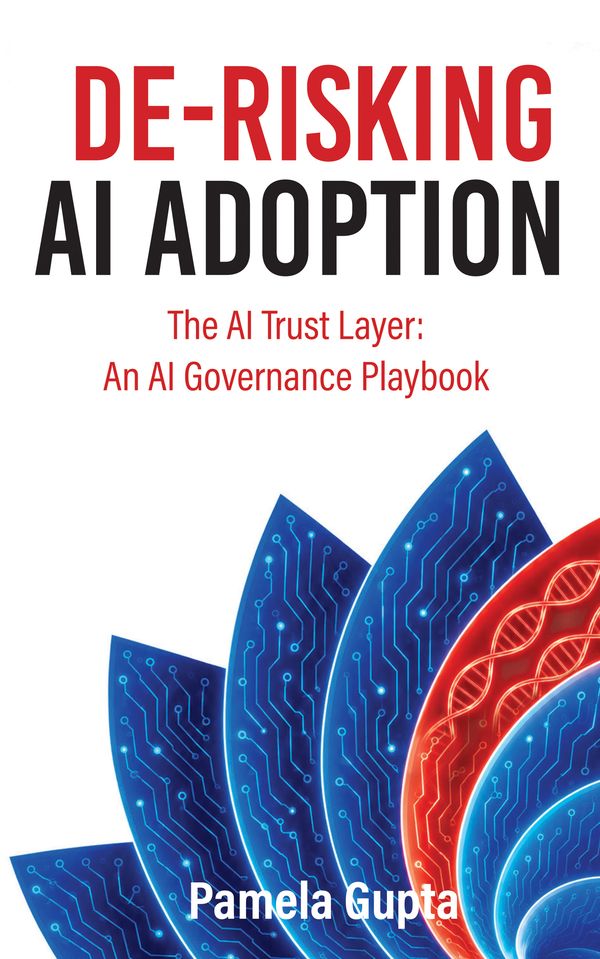
De-Risking
AI Adoption
The AI Trust Layer: An AI Governance Playbook
What leaders are saying
“Congratulations on the publication of your ground-breaking new book… This is a highly accessible must-read for anyone involved in AI Governance. I can’t recommend it highly enough.”
Dr Paul Dongha, Head of Responsible AI and AI Strategy, NatWest. Co-author, Governing the Machine.
“The brilliant Pamela created the AI TIPS™ framework in 2019, four years before NIST AI RMF. This book turns that work into an operating model, not another policy PDF… Within a few years, boards will scrutinize AI governance maturity the way they scrutinize financial controls today.”
Khwaja Shaik, IBM CTO, Board Director.
Most AI initiatives do not fail on the technology. They fail because no one could say which risks actually mattered, or when enough had been reduced to move forward.
Buying for your team or board? Ask about bulk copies and a book session.
From the forewords
“Security alone is necessary, but it is never sufficient. Trust is built from multiple disciplines working together.”
Jim Reavis
Co-founder and CEO, Cloud Security Alliance
“The importance of Trust in AI deployment has never been more urgent than now. In this book she shows organisations how to operationalise AI governance: how to quantify and gate AI risks, in proportion to the risk profile of each AI use case.”
Dr Paul Dongha
Head of Responsible AI and AI Strategy, NatWest
Co-author, Governing the Machine.
“Capital is no longer the scarce resource. Trust infrastructure is. This book turns responsible AI from a statement into an operating model, with named accountability, measurable trust, and a record that stands up to scrutiny.”
Khwaja Shaik
IBM CTO, Board Director
What is inside
AI risks are unique. They are still not well understood. So much so that they become decision blockers.
This book gives boards, business leaders, CISOs, and builders one operating discipline for AI: eight pillars, eighty controls, a gated lifecycle, and a Trust Index that turns governance into measurable, defensible decisions.
It crosswalks to the EU AI Act, NIST AI RMF, ISO/IEC 42001, and CSA AICM. Every chapter closes with Questions for the Boardroom.
- Identify which risks matter Across predictive, generative, and agentic AI.
- Specify the controls that reduce them Eighty controls across eight pillars of trust.
- Require the evidence that proves it Each stakeholder gets the evidence their role requires.
- Measure what remains The Trust Index quantifies the risk that is left.
Reader checklist: before your next AI decision
Choose one AI use case your organization is considering. Bring its business owner, security, risk, privacy, legal and data leads together around three questions.
Can you defend the decision?
Be clear about the intended value, the potential consequences and the conditions for proceeding.
Who is accountable?
Name the people who can approve, change, pause and stop the system.
What is the evidence?
Look for tested controls, documented limitations and a plan to monitor what happens in practice.
De-Risking AI Adoption: reader checklist. Trusted AI, trustedai.ai/book
Your AI decision checklist
Use each item to find the evidence you have and the questions still open.
A starting point for discussion. Completing it does not mean a system is safe or approved. Your selections are not saved.
Frameworks the book maps to
Official starting points to read alongside the book. This is not the full chapter bibliography.
ISO/IEC 42001
The official overview of the AI management system standard. The full standard is sold by ISO.
CSA AI Controls Matrix
A controls framework for assessing and managing AI risks.
Signed and team copies
Want a signed copy, copies for your team or board, or a book discussion with Pamela? Book a short call and we will arrange it.
Work with Pamela
Trusted AI helps organizations manage AI risks and succeed with AI, through consulting, advisory services and practical workshops.
- AI Approval Room workshops for cross-functional teams
- Board and executive AI governance briefings
- AI risk, accountability and control-evidence reviews
- Agentic AI governance and human oversight
Pamela Gupta is the Founder and CEO of Trusted AI, which helps organizations manage AI risks and succeed with AI. She is the creator of AI TIPS™ (Trust Integrated Pillars for Sustainability), a risk-based methodology for measuring and de-risking AI, and a former Fortune 500 Global Information Security Officer.